
Join the 2026 Mobility Data Challenge and help explore, understand, and innovate in urban mobility. The goal is to analyze anonymized individual mobility patterns for solutions to address real-world urban and societal challenges.
Introduction
As part of NetMob 2026, this edition of the Data Challenge continues to highlight and advance research on human mobility, with particular emphasis on public transportation systems. Participants are invited to analyze large-scale urban transit data, identify behavioral and operational insights, and develop innovative solutions to real-world challenges in public mobility.
The challenge is designed to foster creativity, methodological innovation, and interdisciplinary collaboration. Individuals from data science, transportation engineering, urban studies, and related fields are encouraged to contribute, discover, and generate meaningful impact on urban mobility.
 City of Niterói - Rio de Janeiro, Brazil
This edition features the release of a unique and comprehensive dataset from the city of Niterói. The dataset integrates GPS-based trajectories from the public bus fleet, detailed information on bus lines and routes, and anonymized smart card transaction data reflecting passenger boardings. Collectively, these sources offer a multi-layered perspective on the operation and utilization of public transportation in an urban environment.
City of Niterói - Rio de Janeiro, Brazil
This edition features the release of a unique and comprehensive dataset from the city of Niterói. The dataset integrates GPS-based trajectories from the public bus fleet, detailed information on bus lines and routes, and anonymized smart card transaction data reflecting passenger boardings. Collectively, these sources offer a multi-layered perspective on the operation and utilization of public transportation in an urban environment.
All data has been anonymized and processed in accordance with data protection regulations, ensuring privacy while maintaining analytical value. The dataset supports the study of both supply, represented by bus operations, and demand, reflected in passenger usage, thereby enabling comprehensive analyses of urban mobility dynamics.
Participants are encouraged to address emerging questions in mobility science, such as: How do bus network structures influence travel behavior? In what ways can machine learning improve demand prediction and route optimization? What patterns of inequality are present in access to public transportation? How can integrated datasets enhance understanding of system efficiency and resilience? Here are some examples exploring the data.
Whether the focus is on behavioral modeling, system optimization, or policy analysis, NetMob 2026 provides a unique platform to transform data into actionable insights for smarter and more inclusive urban mobility.
How to Participate
Participants are invited to explore this data and submit original analyses, models, or insights. All participants must agree to the Terms and Conditions before accessing the data.
Submissions will be evaluated based on clarity, originality, and potential impact. Winners will be awarded access to data resources and their contributions will be visible within the NetMob community.
Challenge format:
- Prospective participants must apply to the challenge to gain access to the dataset. Access is subject to acceptance of the challenge’s Terms and Conditions. To request access, please complete the Data Request Form below.
- Admitted participants shall submit two-page extended abstracts in PDF format. Each submission must include: a title, author(s) and affiliation(s), email address(es) on the first page, a description of preliminary results from the dataset analysis, and compliance with the official NetMob 2026 paper template.
- Selected participants will be invited to submit a final report consisting of:
- A complete document (no page limits) that will remain confidential and be used to select challenge awardees and to decide whether the work will be presented at the conference as a talk or a poster
- A 2-page summary of the work that will be published in the public NetMob 2026 Book of Abstracts.
⚠️JEMS website is undergoing scheduled maintenance today, July 1st. It should be back by July 2nd, 2026!⚠️
Important Dates
- Challenge launch: May 15th, 2026
- Abstract submission website opening: May 15th, 2026
-
Two-page extended abstracts submission deadline:
July 1st, 2026→July 12th, 2026→July 19th, 2026→ July 21th, 2026 (grace period) -
Notification of acceptance:
July 18th, 2026→July 30th, 2026→August 10th, 2026→ August 14th, 2026 - Abstract Camera-ready deadline: September 6th, 2026
- Early-bird registration: September 7th, 2026
- Full report submission deadline: September 11th, 2026
-
Final notification of presentation and poster:
September 11th, 2026→ August 18th, 2026 - Presentation at the conference: October 16th, 2026
Submission website: Submit here
Dataset Description
The dataset provides a detailed and multi-dimensional perspective of public transport dynamics and passenger demand in the city of Niterói, RJ, Brazil, during March 2026. By integrating complementary data sources, it enables a comprehensive understanding of mobility patterns, user behavior, and external influencing factors.
- Geographic scope: Niterói, Rio de Janeiro, Brazil.
- Temporal coverage: March, 2026.
- Data sources: Bus GPS telemetry, passenger ticketing transactions, and meteorological data.
- Mobility records: High-frequency positional data from the public bus fleet.
- Passenger data: Boarding transactions including fare types and card categories.
- Environmental context: Hourly weather data (temperature, rainfall, wind).
- Formats: CSV, JSON, and GeoJSON.
- Integration: Datasets can be linked through spatial and temporal references.
The dataset includes:
- Mobility dataset: High-resolution GPS traces capturing bus movements across the network
- Ticket dataset: Detailed records of passenger boardings and usage patterns
- Auxiliary dataset: Static transport infrastructure (routes and stops) and weather conditions
- IBGE Census 2022 dataset: Socio-demographic and urban indicators for the city of Niterói derived from the 2022 Brazilian Census
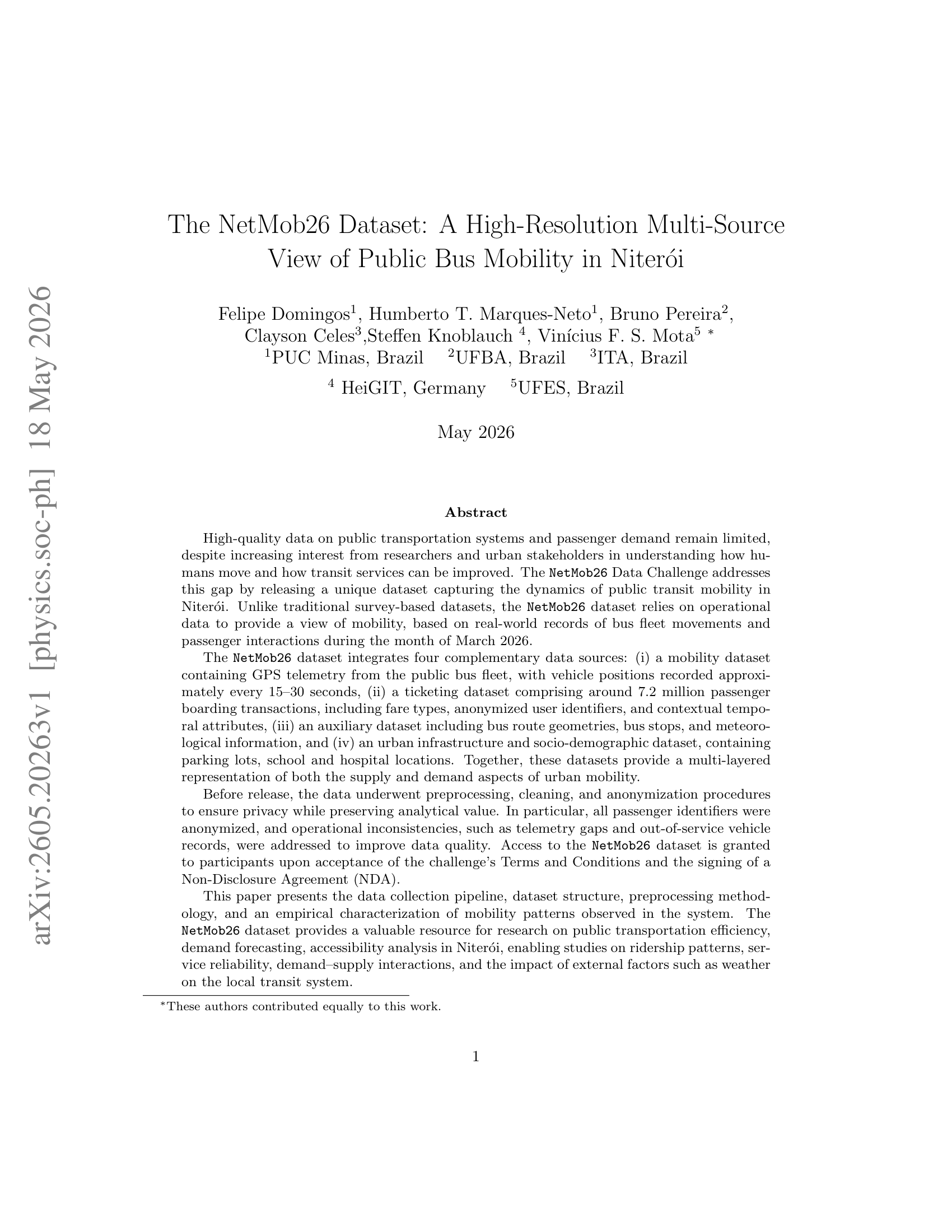
Article describing the NetMob26 dataset
A full description of the dataset is available at https://arxiv.org/pdf/2605.20263. Examples of how to manipulate the dataset are available on GitHub.
How to cite the dataset:
          @misc{netmob26,
            title={The NetMob26 Dataset: A High-Resolution Multi-Source View of Public Bus Mobility in Niterói},
            author={Domingos, Felipe and Marques-Neto, Humberto T. and Pereira, Bruno and Celes, Clayson and Knoblauch, Steffen and Mota, Vinícius F. S.},
            year={2026},
            eprint={2605.20263},
            archivePrefix={arXiv},
            primaryClass={physics.soc-ph},
            url={https://arxiv.org/abs/2605.20263}
          }
Domingos, F., Marques-Neto, H. T., Pereira, B., Celes, C., Knoblauch, S., & Mota, V. F. S. (2026). The NetMob26 Dataset: A High-Resolution Multi-Source View of Public Bus Mobility in Niterói. arXiv preprint arXiv:2605.20263. Retrieved from https://arxiv.org/abs/2605.20263
Domingos F, Marques-Neto HT, Pereira B, Celes C, Knoblauch S, Mota VFS. The NetMob26 Dataset: A High-Resolution Multi-Source View of Public Bus Mobility in Niterói. arXiv:2605.20263 [physics.soc-ph]. 2026.
Suggested Topics
- Passenger demand patterns across bus routes and time periods using GPS telemetry and ticketing data
- Alignment between observed bus operations (GPS) and passenger boarding behavior (ticket data)
- Travel behavior analysis by fare type, card category, or user segmentation
- Detection of short trips, transfer patterns, and potential gaps in service coverage
- Multimodality and integration between bus lines and metropolitan terminals
- Temporal dynamics of public transport usage (peak hours, daily/weekly rhythms)
- Demand estimation, scaling, and representativeness from observed boarding data
- Data fusion: integrating mobility, ticketing, and meteorological data for richer insights
- Impact of weather conditions on passenger demand and system performance
- Biases and uncertainties in GPS telemetry and ticketing datasets (e.g., missing data, delays, validation issues)
Request Dataset Access
To request access to the dataset, you may fill out the form directly below or open the form in a new tab .
Organizers
The NetMob 2026 Data Challenge is organized with the support of the following institutions and research projects: